Quick answer: What is cryptocurrency?
Cryptocurrency is a type of digital asset that can be transferred using computer networks. It commonly uses cryptography—mathematical methods for protecting information—and blockchain-based records to verify transfers without relying entirely on a traditional bank. Bitcoin is one example. Different cryptocurrencies have different rules, uses and risks, and you do not need to buy any to start understanding how they work.
Unlike a photo or document, a digital asset needs rules that determine who can transfer it. Copying a file does not give someone permission to spend another person's cryptocurrency. Network rules and cryptographic signatures help establish that permission.
How does cryptocurrency work?
Imagine sending €20 to a friend through your bank. Your bank checks your account and updates its records; your friend's bank updates theirs. Those institutions maintain the records showing who owns what.
Many cryptocurrencies use a shared digital ledger instead. A ledger is simply a record book. On a blockchain, multiple computers maintain copies and check proposed changes against common rules. The network's way of agreeing on a valid history is called consensus.
This does not mean every network is equally decentralized or has no organizations involved. Networks differ in who can validate transactions and how changes are governed. Exchanges, wallet providers and application developers can also play important roles.
What is a blockchain?
A blockchain organizes records into groups called blocks. Each new block refers cryptographically to an earlier one, forming a connected history. Think of numbered pages in a shared notebook, with each new page also carrying a fingerprint of the previous page.
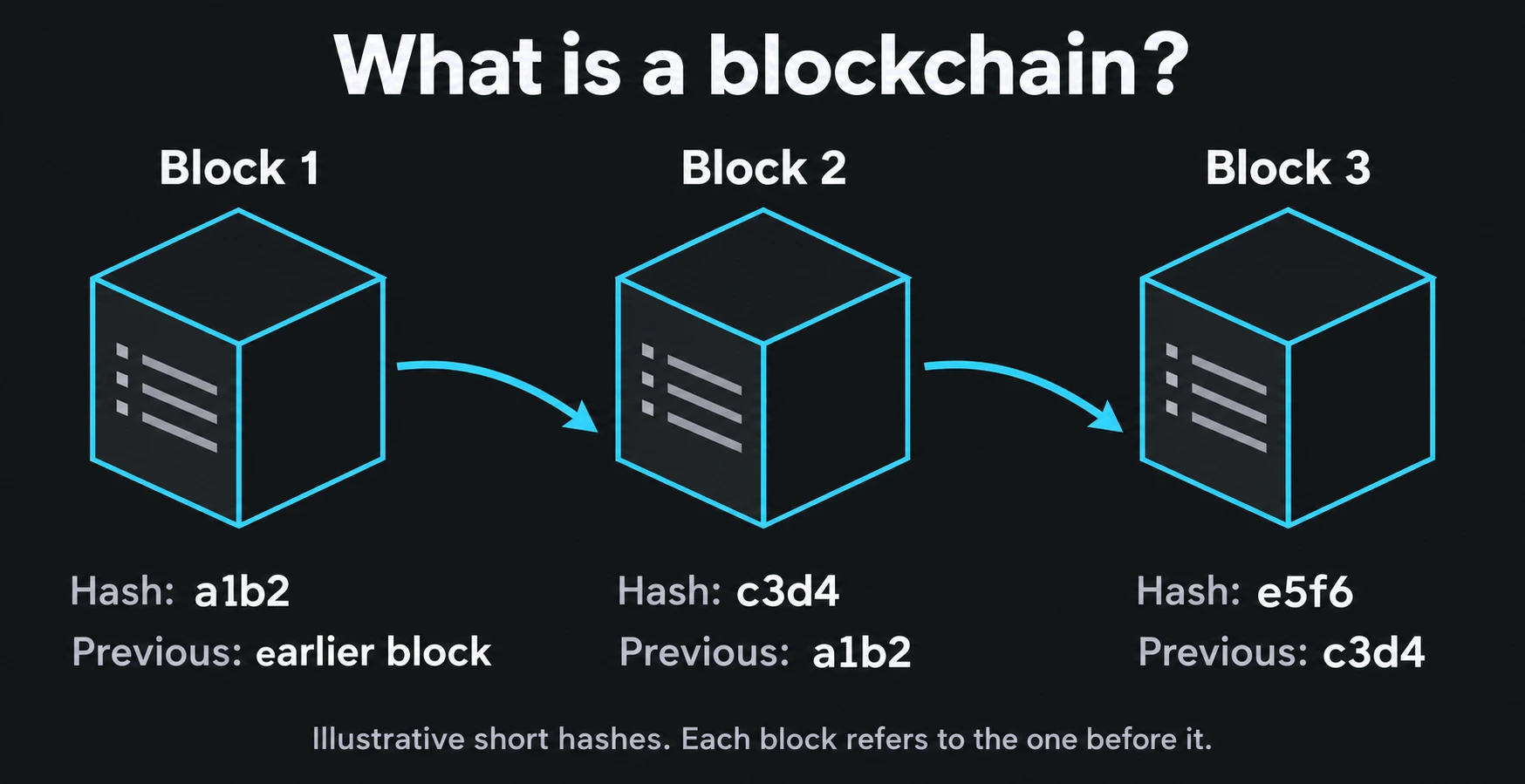
- Block 1Transaction records
- Hash
- a1b2
- Previous hash
- earlier block
- Block 2Transaction records
- Hash
- c3d4
- Previous hash
- a1b2
- Block 3Transaction records
- Hash
- e5f6
- Previous hash
- c3d4
Changing an old record changes its fingerprint and breaks the links that follow it. Network verification makes rewriting accepted history difficult under the network's security assumptions. That is different from saying a blockchain can never fail: attacks, software bugs and control concentrated among participants can affect its guarantees.
Many public blockchains let anyone inspect transactions, blocks and addresses. An address usually appears as letters and numbers rather than a person's name. This is often called pseudonymity, not complete anonymity: other information can connect an address to a real identity.
What are Bitcoin and other cryptocurrencies?
Cryptocurrency is a category; Bitcoin is one member of it. Just as different vehicles have different designs and purposes, digital assets can work very differently.
| Asset | Network | Example use |
|---|---|---|
| Bitcoin (BTC) | Bitcoin | Transferring and holding value |
| Ether (ETH) | Ethereum | Paying network fees and using applications |
| Cronos (CRO) | Cronos EVM | Paying network fees and using applications |
Bitcoin helped establish the idea of transferring digital value without a central payment operator. Ethereum also supports programmable applications. Cronos EVM supports applications compatible with Ethereum's technology. These examples explain functions; they are not investment recommendations.
Coins and tokens
A coin generally means a network's native cryptocurrency. A token is typically an asset created on an existing network, often through a smart contract. These are useful distinctions, although everyday usage varies. Anyone creating a token does not automatically give it value, credibility or a useful purpose.
What can cryptocurrency actually be used for?
Buying an asset in the hope that its price rises is only one activity in crypto. Other uses depend on the network, service and local circumstances.
- Transfers: moving compatible digital assets between addresses, including across borders. Fees, access and legal requirements vary.
- Payments: paying businesses that accept cryptocurrency. Acceptance is limited, and consumer protections can differ from card payments.
- Applications: using games, marketplaces and financial services built around blockchain accounts.
- Digital ownership: recording transfers of particular tokens or digital items. Owning an NFT—a token identifying a specific item or record—does not automatically transfer copyright.
A smart contract is a program on a blockchain that runs predefined instructions. It might record an exchange of tokens or manage access to a service. Automation does not guarantee fairness or security; malicious instructions and programming errors can cause losses.
Stablecoins are tokens designed to track a reference value, often the US dollar. Some depend on reserves; others use different mechanisms. The intended stable price is not guaranteed. Reserve problems, issuer failures or technical issues can cause a stablecoin to lose its target value.
What is a crypto wallet?
A wallet is an app or device that helps you interact with blockchain accounts. It usually manages the keys needed to authorize transactions and shows information such as your balance. Your coins are not physically inside the app: the network maintains the records of assets and ownership.
Addresses, keys and recovery phrases
- Address: a public identifier someone can use to send compatible assets to an account. Always check the receiving network and asset support.
- Private key: secret information used to authorize actions by signing them digitally. Someone who controls it may control the associated assets.
- Recovery phrase: a sequence of words many wallets use to restore access to keys. It is sometimes called a seed phrase and must stay secret.
Custodial accounts and self-custody
With a custodial exchange account, a company manages keys on your behalf. Account recovery may feel familiar, but you depend on the company for access and safeguarding. With self-custody, you control the keys yourself. This gives you direct responsibility: losing recovery information can mean permanently losing access. Neither approach eliminates risk.
What happens when you send cryptocurrency?
For a simple transfer, a wallet prepares the receiving address, amount and network details. The sender reviews them, authorizes a signature and submits the transaction. This walkthrough is an explanation; you do not need to try a real transfer.
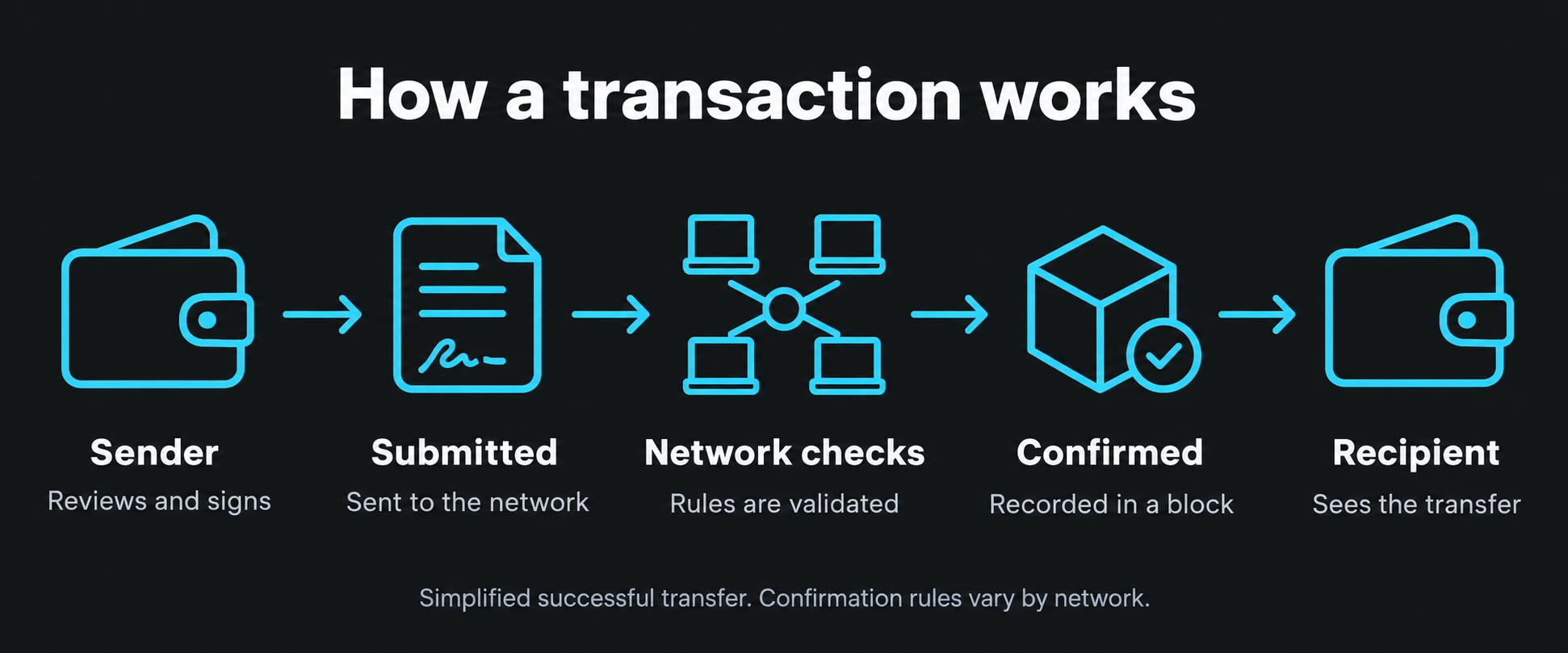
- SenderReviews and signs
- Transaction submittedSent to the network
- Network validationRules are checked
- Confirmed transactionRecorded in a block
- RecipientCan see the transfer
Networks generally charge a transaction fee for processing work. On Ethereum-compatible networks, this is called a gas fee. Ethereum uses ETH for fees; Cronos EVM uses CRO. The cost varies with network conditions and the operation being performed. A failed smart-contract transaction may still consume gas.
A submitted transaction is not necessarily confirmed immediately. Inclusion in a block records it, and the network's confirmation or finality rules determine how settled that record is. An explorer can help you check its status.
Is cryptocurrency safe?
Strong cryptography can protect a transaction record without protecting you from a scam or a falling price. Understand these separate risks before using real funds.
- Volatility: prices can change sharply, and recovery after a fall is never guaranteed.
- Scams and fake tokens: convincing branding, familiar symbols and promises of guaranteed returns can hide fraud.
- Phishing and compromised wallets: imitation websites, fake apps or stolen recovery information can expose assets.
- Smart-contract vulnerabilities: errors or malicious code can allow losses even when an application looks legitimate.
- Service failures: exchanges and other custodians can suffer breaches, financial trouble or withdrawal restrictions.
- Irreversible mistakes: a wrong address, unsupported network or misunderstood approval can have lasting consequences.
Learn first, verify website addresses independently and be cautious about unsolicited offers or pressure to act quickly. An asset appearing on an explorer proves that a record exists, not that the asset is trustworthy.
On Silex, a public listing, contract information and a separate project verification review mean different things. None is an investment endorsement or guarantee of safety or future performance. Research tools make information easier to examine; they cannot remove risk.
Do you need to buy crypto to start learning?
No. You can understand blockchains, inspect public transactions and research projects without buying cryptocurrency, opening an exchange account or connecting a wallet.
A blockchain explorer is a website for browsing network records. You can look at blocks, addresses, fees and supported tokens in your browser. Public information may be incomplete or need interpretation, but it gives you a practical starting point without financial exposure.
Meet Cronos: A real blockchain you can explore
Cronos EVM is a blockchain compatible with the Ethereum Virtual Machine, the environment that runs Ethereum-style smart contracts. Developers can use familiar Ethereum tools to build applications on it. CRO pays transaction fees on Cronos EVM.
Cronos EVM operates separately from Cronos POS, another network in the Cronos ecosystem. Names and assets can overlap across networks, so identifying the exact chain matters. No claim about low fees or fast processing makes a particular application safe.
Silex is an independent research platform focused on Cronos projects. It presents public project information, market context and separate verification signals. You can use it to discover records and compare information while doing your own research.
How to explore your first blockchain without spending money
Try this short activity in your browser. You only read public information; there is no need to sign anything or connect a wallet.
- Open the official Cronos explorer. Find its latest transactions or transaction list.
- Choose a public transaction and open its details. A transaction hash is its unique identifier; it helps you find the same record again.
- Find the status, block, sender (From) and recipient (To or Interacted With). A destination can be a smart contract rather than another person.
- Find the transaction fee. It describes the network processing cost, not necessarily the amount transferred. A contract interaction may also show separate token-transfer events.
- Visit Silex Discover to inspect public Cronos project information. Compare names and contract addresses with independent sources; a listing is a starting point for research.
You do not have to understand every field. Start with status, sender, destination and fee. You have now connected the ideas in this guide to an actual blockchain record, without spending money.
Frequently asked questions
Is Bitcoin the same as cryptocurrency?
No. Bitcoin is one cryptocurrency. The broader category includes Ether, CRO and many other coins and tokens with different rules and purposes.
Is cryptocurrency real money?
Some cryptocurrencies are used for payments, but acceptance and legal treatment vary. Cryptoassets generally do not offer the same characteristics or protections as money in a traditional bank account.
Can you use cryptocurrency without a bank?
Many blockchain transfers do not need a bank to act as intermediary. Buying, selling or withdrawing through a service may still involve banks, companies or payment processors.
Do I need to buy crypto to learn about blockchain?
No. Public explorers and educational resources let you inspect real records without buying assets, creating a wallet or connecting one.
Are cryptocurrency transactions anonymous?
Not necessarily. Many public networks associate transactions with addresses. Other information can link those addresses to real people; privacy differs between networks.
Can cryptocurrency transactions be reversed?
Confirmed transfers generally cannot be reversed like card payments. A pending transaction may sometimes be replaced, or a recipient may return assets voluntarily. Never assume recovery is possible.
Your next step
You now know what digital assets are, how shared records work and why wallets manage keys rather than physically holding coins. You can recognize basic transaction fields and distinguish public information from a promise of safety. Keep learning at your own pace: understanding the technology is valuable even if you never buy cryptocurrency.
Sources & Further Reading
Primary educational and technical resources used to check this guide. Reviewed 14 October 2026.
- Bitcoin.org — How does Bitcoin work?
- Ethereum.org — Crypto wallets
- Ethereum.org — Security and scam prevention
- Ethereum.org — Smart contracts
- Ethereum.org — What is Ether?
- Ethereum.org — Gas fees
- Cronos — Official introduction and network documentation
- Cronos — Official blockchain explorer
- FTC — What to know about cryptocurrency and scams
- Silex — How Silex works
Educational information only; not financial, investment or legal advice. Cryptocurrency involves significant risks, including loss of funds. Research independently before interacting with digital assets.